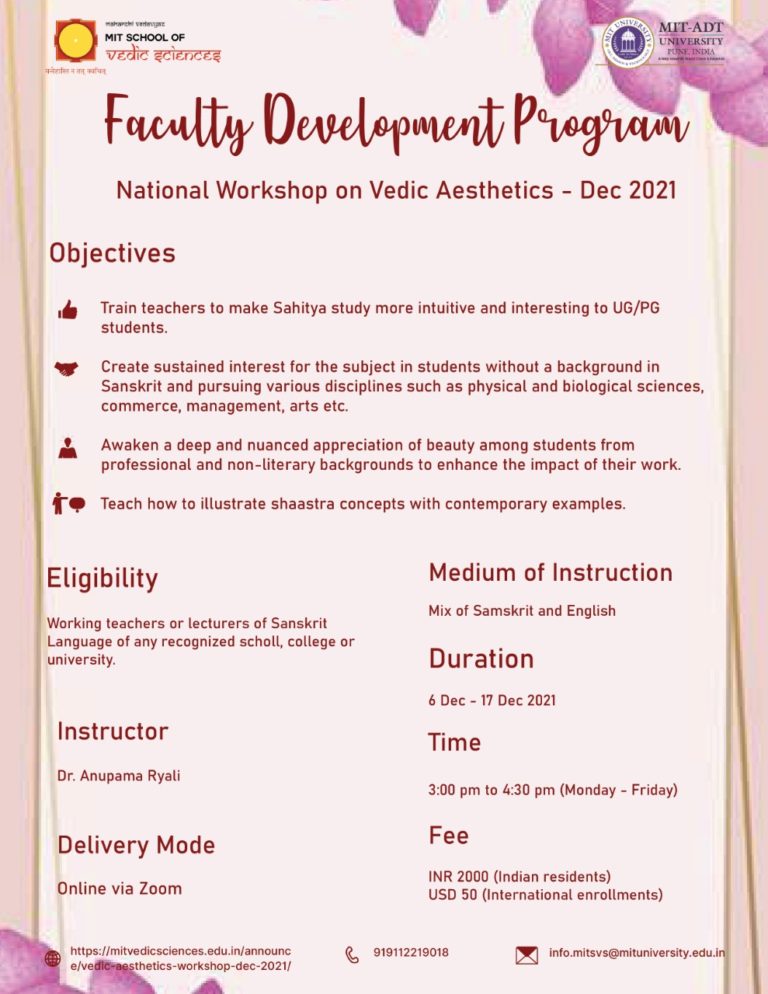
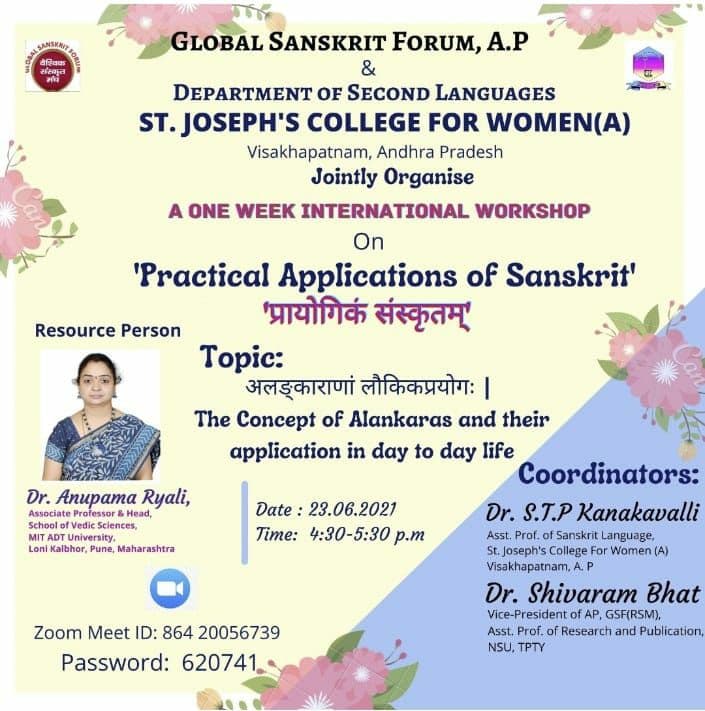
Aim of the Program Aesthetics is the study of the nature of beauty and art. Aesthetic appreciation is the admiration of beauty, such as valuing the fine arts of music, literature, dance, and visual art. Sanskrit literature, which constitutes poetry,…
It is that time of the year when the world marks Mental Health Day. The International Day of Mental Health falls on October 10th and we at MIT SVS Department of Integral Psychology and MIT School of Education and Research,…
MITSVS is making its presence felt in academic circles and we are proud to say that our faculty is getting recognised for making a difference. Two of our faculty, HOD Dr. Anupama Ryali, and Assistant Professor, Prof. Suryanarayana Jammalamadaka have…
Overview Course name: Yoga Instructor Training (YIT) Program (2020-21) Venue: Online and MIT SVS, MIT ADT University campus, Loni Kalbhor, Pune Designer: YogaVahini Course director: Saraswathi Vasudevan, Course coordinator: Uttara Venugopal Duration: One year – 250 hours (first year of BSc Integral Psychology @ MIT SVS) Delivery: Online sessions, online Yoga practice, face-to-face classroom sessions Eligibility: Basic fitness Important dates: Program starts: October 2020, Program ends: June 2021 Enroll: For more information contact on yogavahinimit@gmail.com Introduction YogaVahini is offering the Yoga Instructor Training Program to the students of MIT, Pune, desiring to learn yoga as a means for personal wellbeing,…
Ancient India had a rich scientific tradition based on the tenets of evidence-based reasoning, strong emphasis on systematic thinking and real-world practice. Some of its insights are being discovered to be highly relevant and valuable even today – in mathematics, linguistics, logic, aesthetics, psychology, management and wellness sciences to name a few. India’s analogue of modern science is the shaastra, which has a rigorous definition based on the concept of Yukti or rationality and rules to model real-world phenomena. All Indian shaastras employ a common methodology of structured inquiry and discourse derived from its three native fundamental knowledge sciences –…